Employers Need to Be Monitored: This Year, 9 Student Workers Employed Under the MESEM Program Died
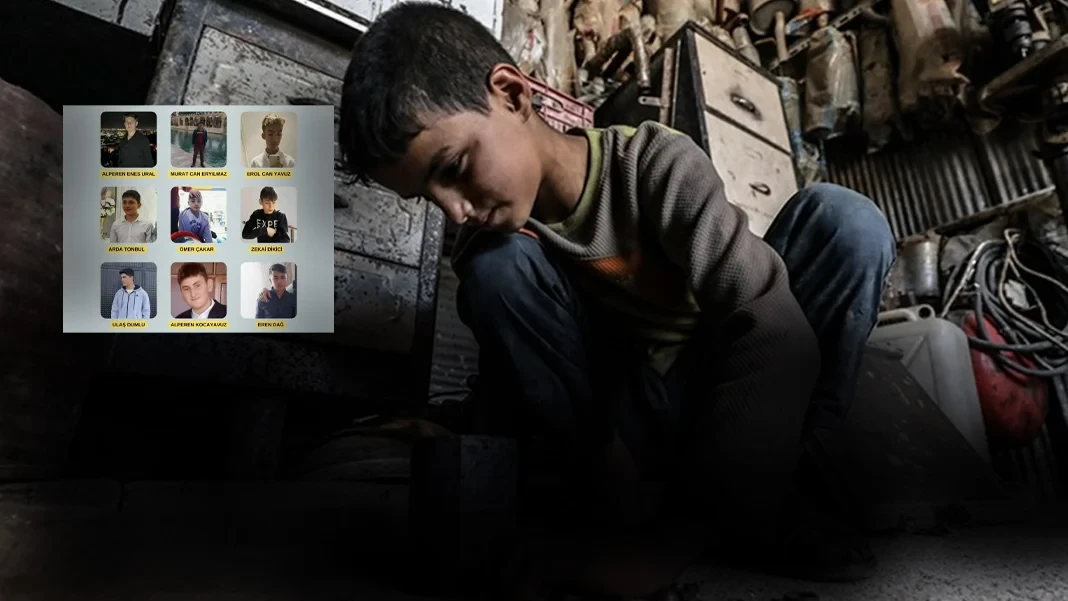
During the 2023-2024 period, 9 child workers died while employed under the Vocational Education Centers (MESEM) program. Kansu Yıldırım, the Ankara Representative of the Workers' Health and Safety Assembly (İSİG), spoke to KARAR about child worker deaths. Yıldırım highlighted that child poverty is being instrumentalized by both the government and employers.
SEMA KIZILARSLAN
At Vocational Education Centers (MESEM), which frequently make headlines due to workplace accidents and fatalities, children are employed under insecure conditions. It is known that over the past 11 years, more than 695 children have died in workplaces where they were employed. In the previous academic year, 9 child workers also lost their lives while working under the MESEM program.
What is MESEM?
According to the Ministry of National Education (MEB), MESEM is a program aimed at meeting the need for skilled workers. The establishment and expansion of MESEM are based on two recent legislative changes. These changes have incorporated apprenticeship training into formal and compulsory education. The ministry states that the goal of the program is "to meet the apprenticeship needs of businesses and to enable apprentice students to learn their profession on the job through the master-apprentice relationship rooted in the culture of ahilik."
Students with at least a middle school education can enroll in MESEM. The training lasts four years. Students work four days a week at a workplace for practical training and spend one day at school for theoretical education and additional lessons. Students who complete 11th grade receive a journeyman certificate, while those who finish 12th grade are awarded a master’s certificate. The program offers 39 fields, ranging from metal technology to furniture and interior design.
Experts say that child worker deaths occur due to insufficient supervision.
In the 2023-2024 academic year, 9 child workers died while working under the MESEM program:
17-year-old Alperen Enes Ural. He was an intern working on a construction site in Soma, Manisa, where he fell from a height while laying natural gas pipes. He passed away in the hospital after five days of treatment.
17-year-old Murat Can Eryılmaz was a 12th-grade student at MESEM in Kilis. He suffered severe injuries after falling from a height while working on a 13-story construction site. He died after 72 days of treatment at Malatya Turgut Özal Medical School Hospital.
15-year-old Erol Can Yavuz was a 9th-grade student in the Interior Design and Furniture Technology Department at Kütahya Vocational Training Center. He died when wooden blocks fell on him in the furniture workshop where he was interning at the Kütahya New Industrial Zone.
14-year-old Arda Tonbul was a worker at Özkanlar Metal Demir Çelik Endüstrisi AŞ. While interning at a workplace in Büyükçekmece, Istanbul, his head got trapped in a sheet metal bending machine for 16 minutes, resulting in severe injuries. He passed away after 6 days of treatment in the hospital.
17-year-old Ömer Çakar was a 10th-grade student at Kayapınar Şehit Abdulvahap Çokur Vocational and Technical Anatolian High School in Diyarbakır. He was interning with an air conditioning technician under the MESEM program. While installing an air conditioner, he fell from the second floor and sustained severe injuries. He died after 6 days of treatment in the hospital.
16-year-old Zekai Dikici was an 11th-grade student in the Electrical Installation Department at the Sümer Oral Vocational Training Center in Alaşehir, Manisa. While installing electrical systems at a construction site, he fell from the 5th floor and died.
17-year-old Ulaş Dumlu was a 12th-grade student in the Electrical Department of ERMES Science and Technical College. During an internship at an electrical company in Ereğli, Konya, he died after falling from an electrical pole into a treatment pool at the Bahri Dağdaş Sugar Factory while fixing a fault.
15-year-old Alperen Kocayavuz was a student at Fatih Sultan Mehmet Vocational and Technical Anatolian High School. During an internship at a construction site in Çubuk, Ankara, he fell into an elevator shaft from the 6th floor and died.
16-year-old Eren Dağ was an intern at a drilling company in Karapınar, Konya. At around 8:00 PM, while working on drilling a well in the Akören area as part of MESEM, he was electrocuted and died.
According to the Organisation for Economic Co-operation and Development (OECD), child poverty in Turkey is higher than the general poverty rate of the total population.
Kansu Yıldırım, the representative of the Labour Health and Safety Assembly (İSİG) in Ankara, pointed out that the cause of child worker deaths is their employment for 30% of the minimum wage:
"Vocational Training Centers are the result of an educational policy aimed at maintaining labor-intensive sectors and regulating the labor market accordingly. According to the Labour Health and Safety Assembly’s data, since 2013, 713 children have died while working, and 9 children died while working under MESEM. Child labor, unfortunately, has become formalized and normalized in Turkey. Practices and protocols such as MESEM are also being legalized.
As of April 2023, production revenues under vocational and technical education have increased to 2 billion lira, with only 300 million lira allocated to students and teachers. Production revenues are estimated to have reached 3.5 billion lira by the end of the previous year.
Students in the 9th, 10th, and 11th grades at MESEM are paid 30% of the minimum wage, while 12th-grade students receive at least half of the minimum wage.
The recognition and facilitation of entry into MESEM stem from the instrumentalization of child poverty by the government and employers. According to TÜİK’s data, in 2023, the rate of poor children is 31.3%, and the rate of children living in material deprivation is 33.3%. This means that three out of ten children live in poverty. According to the OECD, child poverty in Turkey is higher than the overall poverty rate of the population."