Prof. Dr. Naci Görür issues a new warning to Alanya: "The world's largest earthquakes occur in such zones"
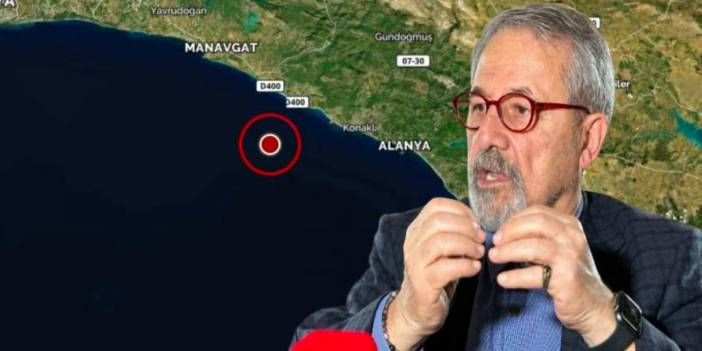
In December last year, following the 5.0 magnitude earthquake off the coast of Alanya, Prof. Dr. Naci Görür, a geologist and faculty member at Istanbul Technical University, made an important statement through Yeni Alanya: "In the event of a potential earthquake, Alanya would be completely devastated".
Görür stated that yesterday's 4.5 magnitude earthquake, like the previous one, occurred in the Hellenic-Cyprus Subduction Zone, on the Anatolian Plate.
THE WORLD'S LARGEST EARTHQUAKES OCCUR IN THESE ZONES
Prof. Dr. Naci Görür noted: "The 5.0 magnitude earthquake off the coast of Alanya occurred within the Hellenic-Cyprus Subduction Zone, on the overriding plate. This recent earthquake also took place in the same zone. Earthquakes in this region are caused by the African Plate subducting beneath the Anatolian Plate. The world's largest earthquakes occur in such zones".
HE HAD WARNED ALANYA BEFORE
Through Yeni Alanya, Görür had previously stated: "In Alanya and Antalya, there is a strange misconception: 'Earthquakes don't happen here.' This is completely incorrect. The faults in this region are indeed slow-moving. These are not earthquakes that occur every 3-5 years. If people were aware of this, no one would speak this way. Subduction zones have slow earthquake generation cycles, which can take hundreds or even thousands of years. However, very strong earthquakes can occur in this region. For example, in the 1800s, earthquakes with magnitudes of 8 and above happened here. This fault zone can produce earthquakes with magnitudes exceeding 7. Because the African Plate is slowly subducting beneath the Anatolian Plate, there is a certain tectonic sluggishness in this area".
THE GROUND IN THE ANTALYA GULF REGION IS WEAK
When generations go a long time without experiencing earthquakes, they begin to say: "Earthquakes don't happen here." Another serious misconception is the belief that "Our ground is solid." Solid? The ground in mountainous areas is indeed strong, but in the coastal part of the Antalya Gulf, both on land and at sea, the ground is extremely weak. Travertines are brittle rocks. They are not as durable as they seem.
NO ONE CAN PREDICT THE DAY OF AN EARTHQUAKE
The region has alluvial deposits, which are water-saturated and loose. Therefore, the ground quality is poor. Hence, the notion that "Earthquakes don't happen here" is misleading. No one can predict the day of an earthquake, but when it does happen, it will cause significant damage to the Antalya region. To the east of Antalya, in the mountainous area, lies the Akşehir Fault Zone. This is an active fault zone of the normal type. To the west is the Fethiye-Burdur Fault Zone, which also continues into the sea. To the north is the Eğirdir Fault Zone, and to the south is the Hellenic-Cyprus Subduction Zone. In other words, Alanya and Antalya are entirely surrounded by fault zones. When these faults produce earthquakes, they affect at least a 100-kilometer radius. The fault zones I mentioned are within 30-40 kilometers. This means a strong earthquake could devastate the Antalya region, especially given the weak ground. And in areas where skyscrapers are built, the destruction would be catastrophic. The ground in the eastern part of Antalya is significantly worse than in the west. Alanya needs to conduct micro-zoning and prepare for earthquakes by building low-rise buildings with extreme caution. This doesn’t mean "An earthquake will happen tomorrow," but if it happens 500 years from now, will we feel any better? By then, it will be our descendants who suffer the consequences.
WE WANT TO CREATE EARTHQUAKE-RESILIENT CITIES
Sooner or later, this earthquake will occur. We don’t want our people to die. We want to create earthquake-resilient cities. But instead, we are building absurd structures focused on profit. We need to use quality materials and apply proper engineering practices. This needs to become part of our culture," he concluded.